By Keith Gangl, CFA®
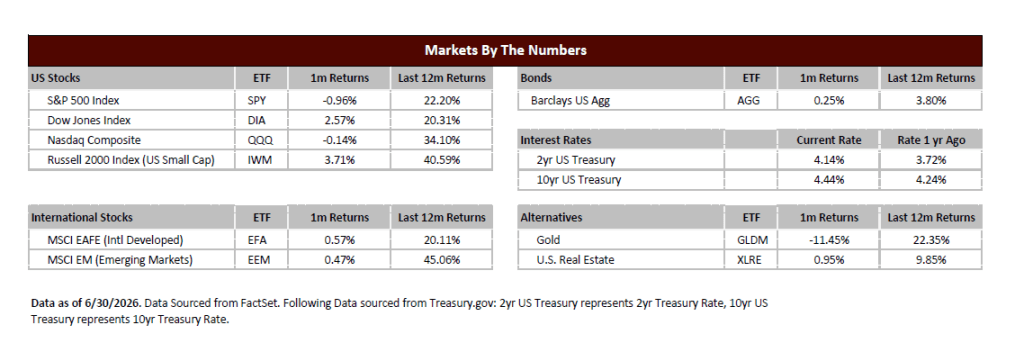
The first half of 2026 ended on a high note, with the second quarter delivering one of the strongest performances in years. The S&P 500 and Nasdaq posted their best quarterly gains since the second quarter of 2020, rising nearly 15% and 21.4%[1] respectively. The arc of 2026 bears a striking resemblance to 2025: both years opened in positive territory, suffered sharp selloffs mid-stride, and then rallied to all-time highs. Last year’s culprit was tariff uncertainty, now a distant memory, while this year’s pullback was triggered by the outbreak of the Iran conflict. In both cases, the market’s resilience proved the more enduring story.
Several themes shaped market performance in the first half of the year: corporate earnings growth, artificial intelligence (AI) compute and capital expenditure demand, the Iran conflict and its effect on oil prices, small-cap stock performance, and a hawkish shift in monetary policy expectations. Despite these crosscurrents, markets moved higher.
AI continued to reshape the competitive landscape within the market. For the past two years, the so-called “Magnificent Seven,” the large-cap technology giants that dominate index weightings, drove the bulk of market returns. This year, however, the script has flipped. While the Mag 7 stocks gained roughly 12%[2] for the quarter, they have lagged the broader technology sector and earned the tongue-in-cheek label “the Lag 7.” The new winners are the companies supplying memory and compute chipsets to these hyperscalers. The Philadelphia Semiconductor Index (SOX), a benchmark for the chipmaking industry, recorded its best quarter ever, surging 88%[3]. Meanwhile, small-cap stocks, as measured by the Russell 2000, posted their best first half since 1991, gaining 21%[4]. This broadening participation, with gains spreading beyond a handful of mega-cap names, is a hallmark of a healthy underlying economy.
Corporate earnings have provided a firm fundamental foundation for the rally. Second-quarter earnings growth for S&P 500 companies is expected to exceed 23%, with full-year growth projected at 24%[5]. Growth at these levels typically follows a recession, when earnings are recovering from a depressed base. Achieving them in an expansion signals genuine underlying business strength.
Not all factors have been benign, though some risks that loomed large at the start of the year have faded. The Iran conflict initially rattled energy markets, sending West Texas Intermediate (WTI) crude above $110 per barrel from a starting point below $60. That spike threatened to squeeze consumer spending and stoke inflation. Since then, oil has retreated to around $70 per barrel, a level that meaningfully reduces pressure on household budgets and removes a key headwind for equity markets.
Monetary policy expectations have also shifted considerably. Entering 2026, investors anticipated two to three Federal Reserve rate cuts over the course of the year. That outlook has since been replaced by expectations for no cuts and a growing possibility of rate increases, as persistent inflation concerns, amplified in part by the oil spike, kept the Fed on hold. Historically, a pivot from a rate-cutting to a rate-hiking posture represents a headwind for equities. Remarkably, markets have absorbed this shift in stride.
Looking ahead to the second half of 2026, the market enters a favorable but complex environment. Strong earnings growth, broadening sector participation, and cooling oil prices provide a solid foundation. At the same time, elevated valuations, unresolved geopolitical tensions, and the prospect of tighter monetary policy leave little room for disappointment. If the first half of 2026 demonstrated anything, it is that markets have the capacity to climb walls of worry, but sustained gains from here will likely require continued earnings delivery and clarity on the Fed’s path forward. We believe investors should stick to their investment plan and stay engaged while remaining disciplined about risk.
[2] Second Quarter Tech Performance
[3] Semis Record Breaking Quarter