By Lisa Schreiber
Markets have a way of reminding investors that no single asset class outperforms across every market environment. Recent market cycles have reinforced the importance of diversification.
As investors seek additional sources of return, income and portfolio resilience, alternative investments have become an increasingly important consideration in building well-diversified portfolios.
While stocks and bonds remain the foundation of most portfolios, alternative investments can offer a valuable addition to a portfolio that’s focused on further diversification, access to unique opportunities and exposure to return drivers that may not be available in traditional public markets.
Historically, alternatives were primarily available to large institutions and ultra-high-net-worth investors. Today, access has expanded, allowing more investors to consider alternatives as a potential component of a diversified portfolio.1
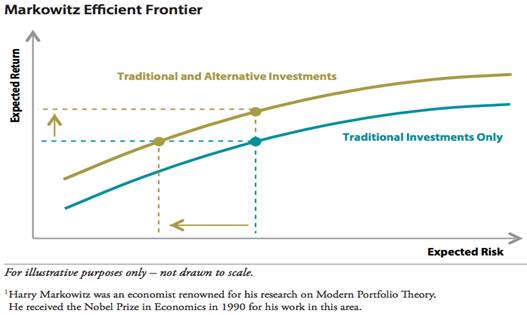
The chart below illustrates the efficient frontier, which shows the optimal combination of investments designed to maximize expected return for a given level of risk. By adding alternative investments with different return characteristics and lower correlations to traditional stocks and bonds, investors may potentially improve the overall risk-return profile of a portfolio.
While alternatives do not eliminate risk or guarantee higher returns, they may provide additional diversification benefits and help create a more efficient portfolio structure.2
The world of alternative investments is broad and can be complex. Each asset class has its own unique characteristics, risks and potential benefits.3
· Private Equity: Investments in privately owned companies or buyouts of public companies.
· Private Credit (Private Debt): Loans made directly to businesses outside of traditional banking channels.
· Real Estate: Investments in commercial, residential, industrial and specialized properties.
· Infrastructure: Investments in essential assets such as utilities, transportation networks, airports and renewable energy projects.
· Hedge Funds: Actively managed strategies that may use leverage, derivatives, short selling and other investment styles.
· Structured Products: Investment solutions that combine traditional securities with customized features designed to provide specific outcomes, such as enhanced income, market participation or downside protection.
· Commodities & Precious Metals: Investments in assets such as oil, natural gas, agricultural products, gold, silver, platinum and palladium, often used as inflation or geopolitical hedges.
· Natural Resources & Tangible Assets: Investments in energy, mining, timber, collectibles and other physical assets.
Like any asset class, alternative investments offer both advantages and disadvantages. Understanding these characteristics is essential when determining their role within a portfolio.
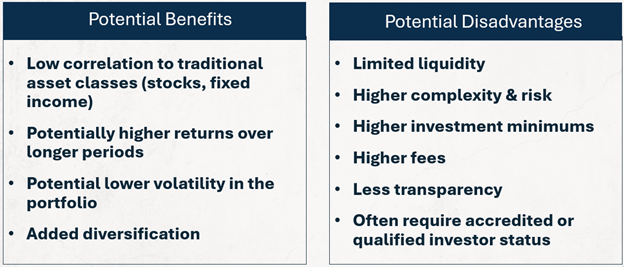
It is important to recognize that these advantages and disadvantages are broad generalizations and do not apply equally across all alternative investments. Private equity, private credit and many private real estate funds typically involve longer investment horizons, limited liquidity and less transparency.
In contrast, publicly traded alternatives such as precious metals and many commodities offer daily liquidity and transparent pricing.
Alternative investments are generally designed to complement, not replace, traditional stocks and bonds. Their role should be based on an investor’s objectives, liquidity needs, risk tolerance and investment time horizon.4
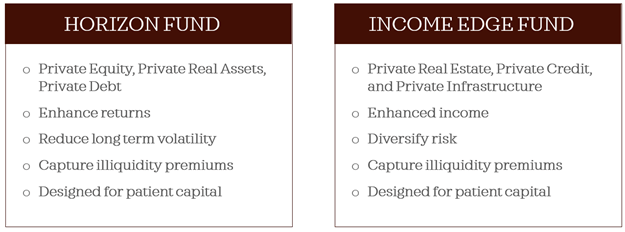
As investors increasingly seek diversification beyond traditional asset classes, Gradient Investments Private Wealth Series provides access to alternative investment strategies designed for both growth and income-oriented investors.
Through the Horizon and Income Edge funds, investors can gain exposure to alternative strategies within a professionally managed portfolio framework.
The information provided herein represents the opinions of the author and Gradient Investments as of the date of publication and is subject to change without notice. This commentary is for informational and educational purposes only and does not constitute personalized investment advice or a recommendation to buy, sell or hold any specific security, including the companies named above. Forward-looking statements, including statements about industry trends, pricing and demand, involve risks and uncertainties, and actual results may differ materially. Investing involves risk, including the possible loss of principal. Data cited from third-party sources is believed to be reliable but has not been independently verified by Gradient Investments.
1 https://www.morganstanley.com/ideas/alternative-investments-portfolio-diversification?
2 https://www.kkr.com/insights/alternative-perspective-past-present-future
3 https://online.hbs.edu/blog/post/types-of-alternative-investments